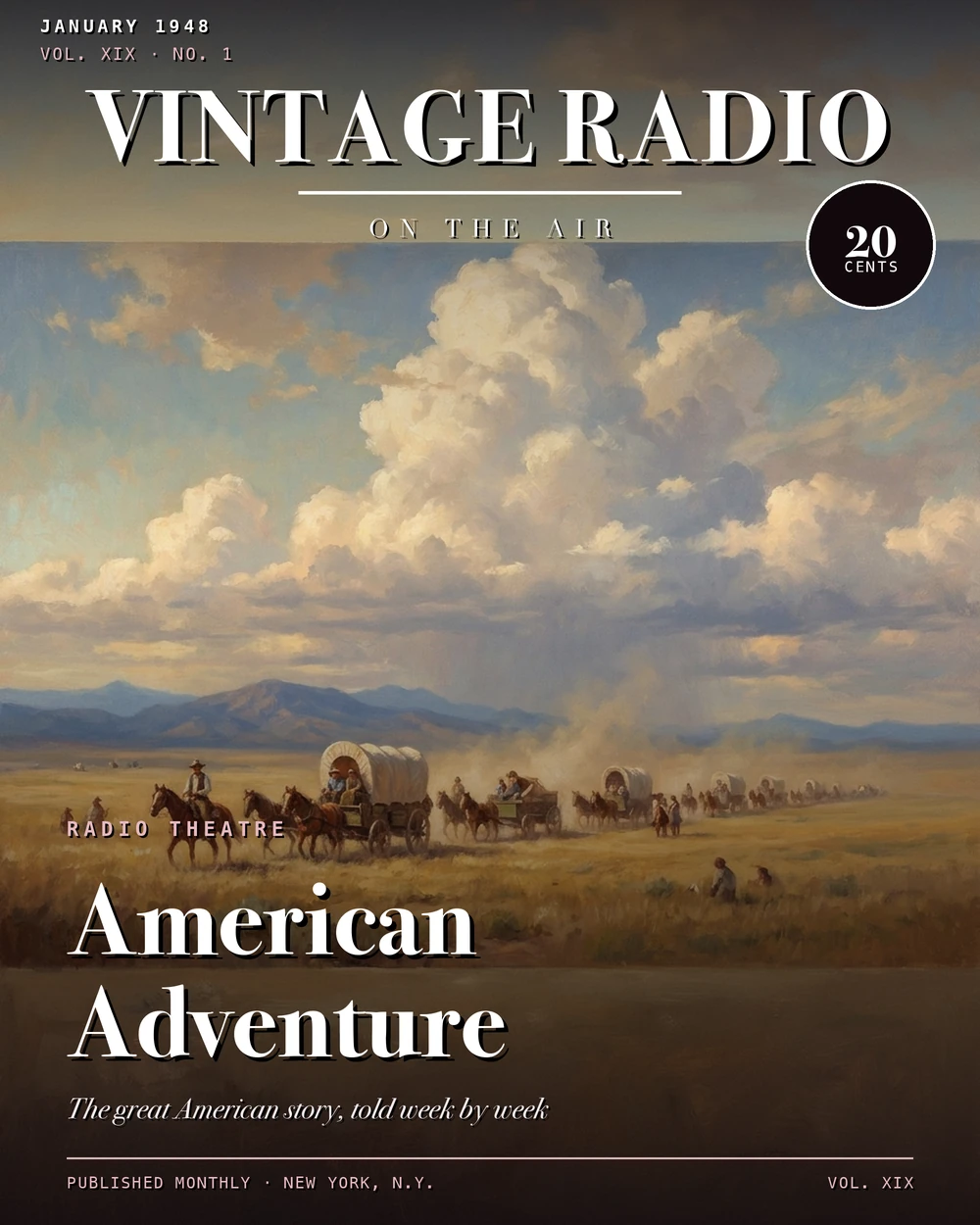
American Adventure
Where It Came From
Most radio dramas in the mid-1950s were built in New York or Los Angeles studio complexes, staffed by professional actors and polished by network machinery. American Adventure was something different. The entire production — cast, crew, and recording — was assembled at the University of North Carolina at Chapel Hill, with faculty members, students, and local townspeople filling the roles. That origin wasn't incidental. It shaped everything about the show: its educational seriousness, its willingness to dramatize obscure corners of history, and its frankly academic ambition to say something meaningful about what America actually was.
The series ran on NBC Radio from the summer of 1955 into early 1956, with 23 known episodes broadcast across that span. It was produced by UNC's communications center and funded through a grant from the National Association of Educational Broadcasters, made possible by the Educational Television and Radio Center. Ford Foundation funding for adult education has also been credited, and the two may refer to overlapping grants rather than separate ones. Whatever the precise financial arrangement, the backing was institutional — a university and a cluster of educational foundations putting money behind the idea that radio could teach history without being dull about it.
Writer John M. Ehle — sometimes logged in broadcast records as "Johnny Lee" — and director John S. Clayton were the two people most responsible for the show's sound and approach. Ehle, born in 1925, was a UNC faculty member from 1951 to 1963 and later built a substantial reputation as a novelist of Appalachian life. American Adventure was an early career credit for him. He had developed his approach to dramatic writing under the mentorship of Pulitzer Prize-winning playwright Paul Green, whose influence on Ehle's dialogue and scene construction is visible in how the series handled historical subjects — not as pageant or recitation, but as living drama.
What the Show Was Trying to Do
The series described its own mission plainly: "a study of man in the New World, of his values and characteristics through the years, who he is, what he believes and lives by." That was the stated premise, and the production took it seriously enough to bring in academic consultants from across the university — departments covering Religion, Anthropology, History, Philosophy, Law, English, and Sociology all contributed. The breadth of that list tells you something about what Ehle and Clayton were attempting. This was not a show that wanted to dramatize the battles and the famous speeches. It wanted to get at something more interior: the people behind the historical record, the choices they made, and what those choices revealed.
The show's philosophical through-line held that America is a young and still-unfinished nation, and that understanding its past is what equips it to face its future. That's a fairly serious argument to embed in a 30-minute radio drama, and the production mostly committed to it. The result was a series with an unusually wide range of subject matter — from a Southern plantation in the early 1800s to building a house during the Great Depression, from African American soldiers in World War I to the legend of Johnny Appleseed.
Three series of American Adventure were produced in total, but only one — the 1955–1956 run — aired on a national network. The earlier versions stayed within UNC's own student radio station and never reached the broader NBC audience.
The Episodes and the People in Them
The surviving episode titles point toward how eclectic the series was willing to be. "Builders on the River," "The Story of a Poet," "Hearth Fire," "The Pioneer Call — Eli Lige," "Ezra Lee — Man of Iron," "John Williams — Runaway Justice," "The Demagogue," "Joe Palmer — The Free Man" — the range in subject and register is striking. Some episodes took on well-known historical figures. Others dramatized people and events far outside the standard American history curriculum, which was presumably the point: if the show had only covered Washington and Lincoln, there would have been little reason to involve historians and anthropologists.
One episode dramatized George Washington Carver, but with a deliberate angle — the focus was on Carver's personal dignity rather than his scientific achievements. That choice reflects the humanizing approach the series applied throughout. Another episode, "Grandfather Jefferson," was written from the perspective of Thomas Jefferson's grandchild, with source material drawn from author Sarah Randolph, herself a granddaughter of Jefferson. Writing Jefferson through a grandchild's eyes, drawing on a descendant's own account, is a long way from conventional historical drama.
The first broadcast episode, aired July 28, 1955, was titled "A King with a Crown." One of the most notable early episodes was "Hearth Fire," broadcast August 4, 1955, which dramatized the TVA's building of lakes. That episode featured Charles Kuralt — then a UNC student, later one of American broadcasting's most recognized voices — in a starring role. His appearance is a small footnote in the American Adventure record, but it connects the show to a broader story about what UNC's communications environment was producing in that period.
The Sound and the Format
Each episode ran approximately 30 minutes and used a combination of narration, dramatic reenactment, sound effects, and music. The narrative format leaned on a dramatic style designed to keep listeners engaged rather than lectured at. That balance — between the educational mission the funders wanted and the entertainment value a general NBC audience required — was the central production challenge, and it shaped choices at the script level as much as at the studio level.
The cast being drawn from faculty, students, and Chapel Hill townspeople gave the recordings a texture somewhat different from shows made with professional New York actors. Whether that reads as roughness or authenticity depends partly on the episode, but it was a consistent feature of the series and a natural consequence of where it was made. The American Archive of Public Broadcasting, held at the Library of Congress and GBH, preserves recordings from the series, with metadata confirming Ehle as writer and Clayton as director across the run.
Why It Holds Up as a Historical Record
American Adventure sits in a specific moment in American educational broadcasting. It was funded by organizations explicitly trying to develop radio and television as tools for adult education, built inside a university communications program, and shaped by a writer who would go on to a significant literary career. The 23 episodes represent a genuine attempt to use dramatic radio to do something more than entertain — to argue, through story, that history is how a country understands itself.
Ehle's later career as a novelist, particularly his Appalachian fiction, shares the same instinct: that the lives of ordinary and overlooked people are where a culture's real history lives. American Adventure was where he worked that instinct out in radio form, under the influence of Paul Green and with the support of a university that was, briefly, willing to put that argument on NBC.